
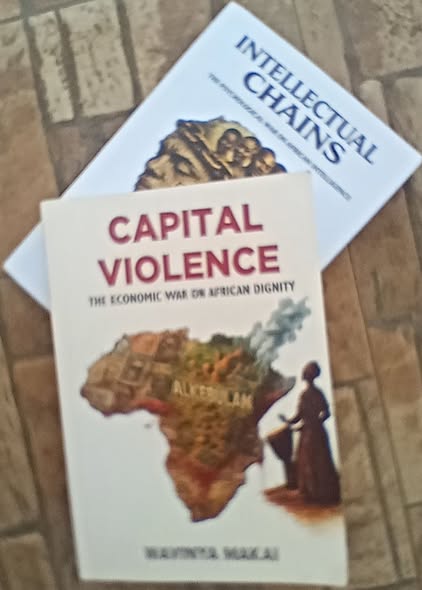
 Metaphorically speaking, Capital Violence and Intellectual Chains are two square objects in the round-hole mind of human exploitation and colonial philosophy. There were fundamental and forceful reasons supporting the interests of Europeans and Arabs who invaded Africa for centuries. There is an African saying that he who wants to eat a hyena justifies it by claiming it is too young to have eaten a human being. For, if the hyena is mature nobody would eat it because hyenas eat human beings.
RELATED: Ngugi wa Thiong’o’s 4-Chapter Book Looks at the Entrenchment of Colonialism and Neo-Colonialism
The slave traders and colonials developed social theories regarding why they invaded Africa. They knew, of course, Africans were human beings. But they justified their behaviour by claiming those beings were uncivilized and should be taught how to be civilized through being subjected to labour. They were pagans and should be taught new and civilized religions to save them from paganism. In other words, the sword or bullet with which they killed Africans was money alias materialism. They were/are monsters religiously interested in using Africans as tools for manufacturing wealth. In African metaphor, they saw/see Africans as livestock and did/do what livestock farmers do to livestock.
RELATED: Creative Workshop Focuses on The Business of Art
 Wavinya Makai presents African categorical tools of engagement in fighting capital brutality from traditional African exploiters.
In the 342-page Capital Violence, Wavinya specifies the various tools that over the years were employed by the monsters as: The monsters’ beautiful lie. The price of poverty. Debt as discipline. The tyranny of Aid. Our elite complicit. Blood in the boardroom. Development as dispossession. Gendered violence in capital systems. Miseducation of Africa. Resisting the empire.
RELATED: Black People Verified
In the 325-page Intellectual Chains the subjects are: The gospel of amnesia. When knowledge becomes a colony. The script of forgetting. Language in exile. The textbook as weapon. Professors of empire. The betrayal of Pan-Africanism. The pedagogy of silence. Counter-classrooms. The syllabus of freedom.
RELATED: Leading Writer to Deliver Topical Public Lectures
 Wavinya’s mental pregnancy has given birth to twin sisters in the two authentic and thoroughly researched books of African thought and subsequent reaction. Both books bear the signature of pride in African scholarship in the manner in which they substantiate her delivery richly armed with quotations from works of African great minds, which is unclassical in philosophical arguments of works by African scholars who are given to insatiable quotations from works by non-African scholars; hence, dismaying grave disrespect to African academic thought. They sound and appear foreign in their cultural roots because they see the African world only through Whiteman’s spectacles.
There is no way one can summarize the contents of these books. The contents and arguments behind them stand out as a great challenge to the African thought of change. The arguments are delivered with audacious colour and honestly. The books are not presenting sheer lamentation of the African fate, but cardinal laws for the African with which to take charge of his destiny.
Review by David G Maillu